#2. Privotal Speech
-P86 where Kahu is giving a speech about her love to Koro
-Strong love of Kahu vs. Indifference of Koro(contrast)
-Totally dark background with two spot light: one on Kahu with traditional Maori clothes and the other on an empty chair(at that time, all Kahu cares about is the empty chair)
-Speech in both Maori language and English(Kahu’s connection between Koro: both want to preserve the old Maori culture)
-1)Trigger empathy of audiences 2) make audience concern about Kahu and Koro’s relationship 3)forshadowing Kahu’s destiny which is same as Koro 4)Koro misses a chance to figure out Kahu’s ability(several times)
#2. Convey atmosphere
-P102 where many people in the village are trying to save the whales from death and bad people
-1)the unity of a herd 2)even without the leader in chaos, they are spiritually united
-Kahu’s uncle(naughty/modern villagers) and police officers, olds(preserve) and young are all getting together for the same goal although they may have may arguments in the past
-the whale is in a human shape with blue costume and many valueable jewelries so that several youngs are trying to steel them
-others are busying keep him safe and drive bad people away
-sound effect: whale groaning, news report, policy cars, helicopters… to set off the chaos and intense sense.
Thursday, April 14, 2016

Another Group's Answers
Chapter11 71- 72
The conflicts between the modern outside influence and the old Maori tradition.
Koro will stand in the center of the stage, asking himself whether he should embraced the change in their society or just living in the old way. He should be appeared to be confused, and in the final sentence he will say, he can face directly at the audience, saying " oh, ancestor which way should we go". On the left stage, there will be actors acting like they are living in the old tribe while on the right stage, there will be people wearing in modern costumes, using technologies like phones.
Costume
The way they greet each other.
Different questions different actions.
Differences on costumes, settings, lightings, music.
Chapter18 133
It is scene where Kahu is riding the whale and leaving from the beach while Nanny gives the stone to Koro.
At the first, he did not believe she is one and was annoyed to find out that she disappear from his sight again. Then, after Nanny gives him the carved stone and telling that Kahu is the leader he always looking for. He realizes and look at the audience with regret. He walk to downstage and start to talk about the small details he ignore in the past such as Kahu bites his tone. Flashback actors acting behind him. Comparison on emotion. Finally he turn to Kahu extend his arm and shout out you are the chosen one with jouful tears. Let it be done.
Putting a camera to video the face of Koro and project to the back stage using the projector.
The music will be at first a traditional Maori music with low voice then change to some kind of modernized one.
Wednesday, April 13, 2016
One group's notes for Sample Questions
Q. Select a passage from a novel you have chosen to study which deals with despair and euphoria. How might staging, design and acting combine to register one of these experiences for an audience?
A passage from the novel that deals with despair is: “[Koro says] ‘Distinguished guests, members of the audience, my speech is a speech of love for my grandfather, Koro Apirana’” (p.86). This is when Kahu has a performance with Maori traditional dance and music with other children. She prepares a speech for her grandfather in her own culture's language to make him proud, but he never shows up. She must be disappointed and depressed because she was excited to show how she can speak Maori language better than other boys and break the grandfather’s conservative ideas.
To show Kahu’s despair, she should cry while she is giving a speech like in the film to make the audience feel sympathetic to Kahu. The actress who acts Kahu should also make a pause between lines during the speech to show that she is kind of nervous and waiting for the grandfather. Because she is giving a performance that is about Maori culture, her costumes would be traditional style clothes like Native American with feathers. She should also have some decorations on her face or hands like henna. But since the setting is in 21st century, the actors who act audiences in this scene should wear suits and dresses to represent modernism. In addition, the place where Kahu performs should be like a modern setting like Black Box or an auditorium. Kahu will be singing and dancing with other children.
Kahu is giving a speech to the audience on a raised platform but the actors who act the audience on the stage will be behind her. The well visible spot will be empty to indicate that is the empty reserved seat for the grandfather. While she is giving a speech, she will look back and check that the seat is still empty and look front to the audience and continue the speech with a depressed face.
Q. Select a passage from a novel you have chosen to study which deals with loss. Discuss how you
would stage this in order to convey to the audience the meaning of that loss.
A passage from a novel that deals with loss is:”The old man understood. He raised his arms as if to claw down the sky upon him” (p.133). After Kahu rides the bull whale and disappears, Nanny Flowers gives the stone, which Koro has thrown away in the ocean and tells boys to get it, and tells him that Kahu is the one who brought the stone. He then realizes that Kahu has special ability to communicate with animals like Maori people’s ancestor and that he was wrong. He was only looking a male leader who can lead the Maori tribe after him, so his attitude towards Kahu was cold, but he realizes the gender does not matter. We think this passage is associated with three different types of loss. It can be loss of great-granddaughter, loss of leader of Maori people, and loss of Maori culture.
To indicate the loss of Kahu in general, Nanny Flowers cries after she leaves with the whales. After Nanny gives the stone with shaking hands to the grandfather, she should leave him alone and leaves the stage so the audience can only focus on Koro. After she leaves, Koro looks at the ocean that Kahu disappears and stares at it for a few seconds and drops his knees on the floor to show his confusion with his feeling of loss. Without saying anything, he will raise his arm as if he wants to catch Kahu.
The digital project will be used to show that the ocean and the whale are special and mysterious. The whale and Kahu will be shown as shadows and on the stage left up corner as if they are flying away from Koro. Koro and Nanny Flowers are standing on stage right to show the hugeness of ocean. Bluish and yellowish colors will be presented through digital projection to produce
Monday, April 11, 2016
Sample Essay Questions for Exam 1 (Paper 1)
Here are some additional essay questions. I will choose some from here for Friday's practice exam.
1. Select a passage from the novel you have chosen to study and, showing how the mood and atmosphere is evoked in the passage, explain in detail how you would create this mood and atmosphere in performance for an audience.
2. Choose a passage from the novel you have chosen to study which emphasizes the difference in status between two or more characters. How would you present this passage on stage in order to communicate these differing statuses to an audience?
3. In transforming prose to performance for an audience, the representation of physical description is a challenge that must be overcome. Select a passage from the novel you have chosen to study which features an extended description of a place, or a significant action, or a character. Discuss how you would use performance to transfer one of these to the stage.
4. Novels often include funny episodes. Choosing one comic passage from the novel you have studied show how you would present this passage to entertain an audience.
5. Novels often devote passages top the development of one character. Through focusing on one passage of this kind show how such a focus could be made fascinating for an audience
6. Choose one passage from the novel you have studied that might be considered climactic. Show how you would stage this passage to convey the excitement of the original to the audience.
7. Select a passage from a novel you have chosen to study in which a character makes a crucial discovery. Discuss how you would convey this moment in performance for an audience.
8. Select a passage from the novel you have chosen to study and show how the descriptions of setting and action may be registered in the stage design and the performances of the actors.
9. Select a passage from a novel you have chosen to study which involves an antagonistic scene between actors. How would you stage this scene for an audience to convey the significance of this conflict?
10. Select a passage from a novel you have studied which presents a social gathering of some kind. Discuss the presentation and importance of this passage, showing in detail how it could be realized in performance.
11. Choose an extract from the novel that provides an insight into a key concept or theme. Explore the way this concept or theme is depicted and how it might be conveyed in performance.
12. Select a passage from the novel which focuses on the introduction of one or two key characters. Examine the presentation of the character/s and ways you would convey their introduction to an audience.
13. Elements of exaggeration, the grotesque or the ridiculous are often subjects for fictional representation. Select a passage from a novel you have studied to demonstrate how one or more of these elements might function in a staging of it for an audience.
14. In any dramatization of a prose passage the question of how characters move and interact on stage is fundamental. Select a passage from the novel you have chosen to study and demonstrate how your characters would move and interact on stage in order to communicate the meaning of the passage to an audience.
15. In many passages from novels the reader is made aware of the private, interior worlds of the narrator or of characters. Select a passage from the novel you have studied and explain in detail how you would bring out this interior life in performance for an audience.
Friday, April 8, 2016
Some examples of Stage Design Dioramas
Here are two from productions of Once on This Island:


And here are two from productions of The 25th Annual Putnam County Spelling Bee:


Google your favorite play or musical to find more examples.
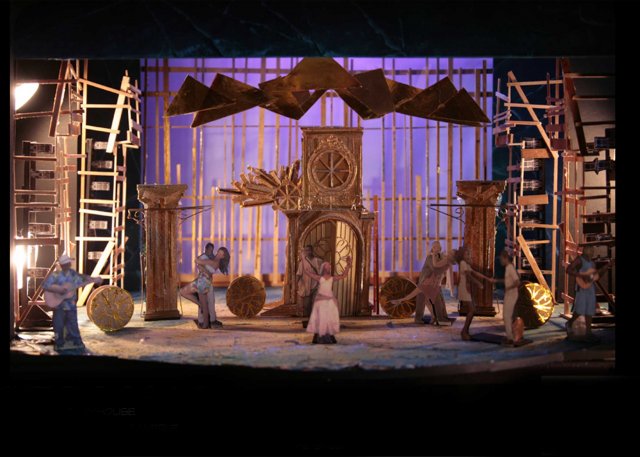

And here are two from productions of The 25th Annual Putnam County Spelling Bee:


Google your favorite play or musical to find more examples.
Wednesday, April 6, 2016
Important passages from the novel
1. The trouble was that Koro Apirana
could not reconcile his traditional
beliefs about Maori leadership and
rights with Kahu’s birth.
2. ‘Go away,’ Koro Apirana would thunder. ‘Go. Get away from here,’ he repeated. ‘Go away. You are of no use to me.’
2. ‘Go away,’ Koro Apirana would thunder. ‘Go. Get away from here,’ he repeated. ‘Go away. You are of no use to me.’
3. For the rest of that evening the seat
beside Nani Flowers remained
empty, like a gap in a row of teeth.
4. ‘When it dies, we die. I die.’
‘No, Paka. And if it lives?’
‘Then we live also.’
5. ‘I should have known that she was
the one,’ Koro Apirana said.
6. Oh, yes, grandchild. Rise up from
the depths of your long sleep.
Return to the people and take your
rightful place among them.
7. ‘You’re the best grandchild in the
whole wide world,’ he said. ‘Boy or girl, it doesn’t matter.’
Whale Rider Review
Here is a site that contains a good basic study guide for the novel:
http://www.mskenny.com/whale-rider-novel-study.html
Subscribe to:
Posts (Atom)